Before the Sample Changes: A Matrix-Bridging Dossier for UK Antibody Assays
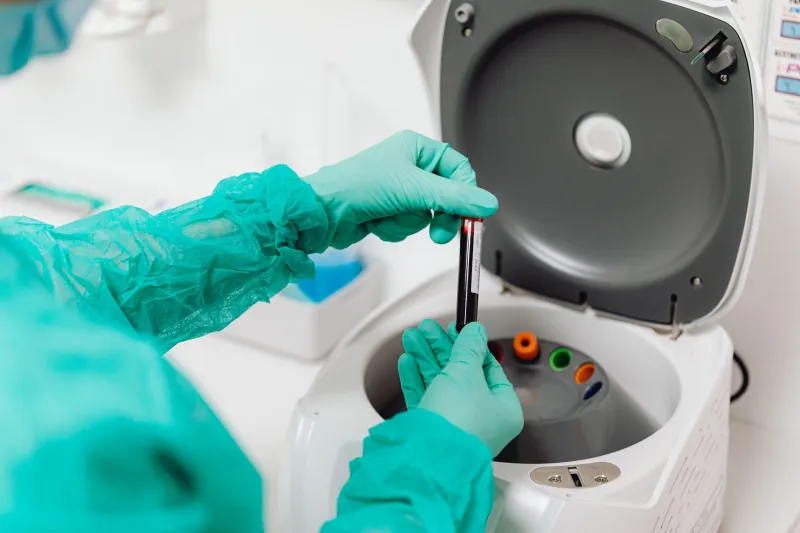
The matrix is not a neutral carrier
When an antibody assay moves from serum to plasma, or from venous blood to a capillary sample, the change is often recorded as a sample-type variation. In analytical terms it is closer to a method change. The antibody, the antigen, the buffer and the detection chemistry all remain the same on paper, yet the fluid in which they meet has changed. Proteins, lipids, cells, anticoagulants and collection artefacts can alter binding kinetics, signal generation and nonspecific background. For UK laboratories, the practical question is not whether serum and plasma are broadly comparable, but whether the specific assay, for the specific intended use, has evidence that the two matrices behave comparably.
A matrix-bridging plan should therefore be treated as part of assay development and change control, not as a final validation formality. It needs to state what is being bridged, why the new matrix is required, which populations and collection pathways will use it, and how comparability will be judged. Without that structure, a laboratory can accumulate data without acquiring a defensible claim.
Anticoagulants are reagents in disguise
Plasma is not serum with an added tube colour. The anticoagulant used to produce it can influence antibody assays in several ways. EDTA binds divalent cations and can affect metal-dependent interactions, enzyme labels or assay buffers that rely on calcium or magnesium. Citrate dilutes the sample and alters ionic strength, which may shift binding or detection efficiency. Lithium heparin can interfere with certain immunoassays and may affect polymer or bead interactions. The magnitude of these effects is assay-specific, so generic statements about plasma suitability are of limited value.
A bridging plan should identify the anticoagulant intended for use and, where relevant, compare it against serum and against alternative anticoagulants. Tube fill volume and order of draw matter because they change the ratio of anticoagulant to blood. Under-filled citrate tubes, for example, effectively alter the matrix. The dossier should record collection instructions, acceptable fill ranges, mixing and centrifugation conditions, and any limits on storage before testing. If the assay is intended for both serum and plasma, the claim should say so explicitly and identify the anticoagulant types covered by the evidence.
Haemolysis and lipaemia: visible and invisible interference
Haemolysis and lipaemia are familiar interference categories, but they deserve particular attention in matrix bridging because their frequency changes with collection route. Capillary sampling, difficult venepuncture, prolonged tourniquet application and delayed processing can all increase haemolysis. Lipaemia varies with patient population, fasting status and sample handling. Visual inspection is useful for gross interference, yet it is not a quantitative control. A sample that looks clear may still contain enough haemoglobin or lipid to affect an assay near a clinical decision point.
The bridging dossier should include both spiked and native panels. Spiked samples can explore interference across a concentration range, while native samples from the intended population can reveal whether the effect occurs in practice. Acceptance criteria should be set in advance and linked to clinical performance, not simply to a percentage change in signal. For assays used near a cut-off, concordance around that cut-off is more informative than a correlation coefficient across the full measuring range.
Collection and transport are part of the matrix
In the UK, antibody assays may be requested through hospital laboratories, community diagnostic centres, primary care networks or home-sampling services. Each pathway introduces its own variables: tube type, phlebotomy training, transport time, ambient temperature and the interval before centrifugation. Capillary blood is particularly sensitive to collection technique. Tissue fluid contamination, insufficient volume, haemolysis and delayed separation can all change the specimen in ways that a venous serum sample would not experience.
A bridging plan should map the collection pathway as carefully as it maps the analytical method. It should specify the intended sample types, the devices and tubes permitted, the handling steps that must be performed locally, and the maximum transport and processing intervals supported by evidence. Seasonal temperature variation is a genuine consideration for UK transport, particularly where samples move between community settings and central laboratories. The plan should also address what happens when a sample falls outside the validated pathway: rejection criteria, recollection guidance and a route for recording deviations.
What the bridging dossier should contain
A useful dossier begins with intended use. It should define the clinical question, the population, the sample types claimed and the collection routes covered. The comparability protocol should then describe the sample panel, the reference matrix, the number of samples, the concentration range and the statistical approach. Passing-Bablok regression, Bland-Altman analysis and bias estimates are common tools, but they are only part of the picture. Clinical concordance, particularly around decision thresholds, should be presented alongside analytical comparison.
The dossier should also record the anticoagulant and tube types tested, the haemolysis and lipaemia experiments, the stability data supporting transport and storage, and the acceptance criteria used to judge success. Where a claim is limited to one anticoagulant, that limitation should be stated plainly in the instructions for use. Change control should link the bridging evidence to the assay version, the reagent lot and the collection device. Post-market surveillance should include a mechanism for reviewing matrix-related complaints and, where necessary, updating the bridging evidence.
Evidence, accreditation and the UK context
For UK diagnostic manufacturers, sample-type claims sit within the wider evidence base for UKCA marking and, where applicable, MHRA requirements. For laboratories accredited by UKAS to ISO 15189, verification of sample-type suitability forms part of the broader validation of the method in the local setting. The bridging dossier does not replace either framework, but it gives both a clearer technical foundation. It also helps procurement and clinical teams understand what a sample-type claim actually covers.
Matrix bridging is not a single experiment to be completed and filed. It is a structured argument that the assay remains fit for purpose when the specimen changes. In a health system where collection routes continue to diversify, that argument deserves to be made deliberately, documented transparently and reviewed when the pathway changes.