Lateral Flow's Quiet Reappraisal: Polyclonal Antibodies in UK Diagnostic Development
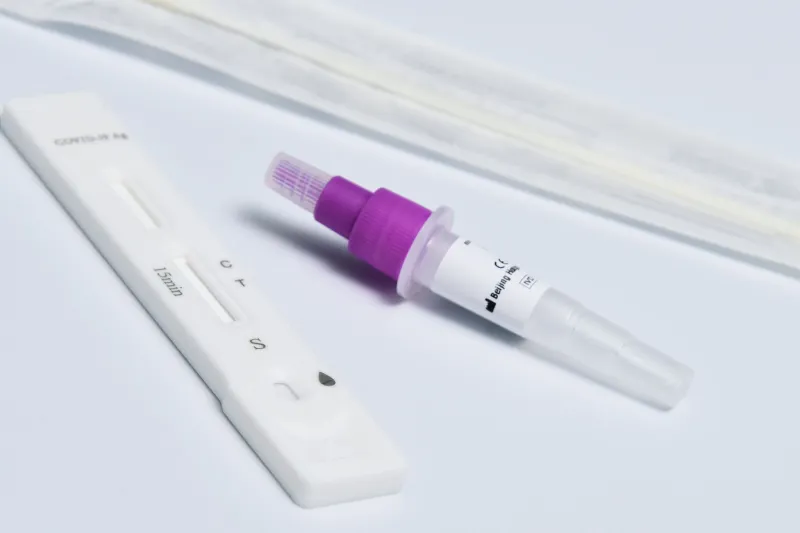
Lateral-flow diagnostics have long been treated as the workhorse of point-of-care testing: inexpensive, fast and familiar. That characterisation undersells the technical demands now placed on them. NHS-facing developers are asking for assays that perform in capillary blood, saliva and nasal matrices, retain sensitivity at low analyte concentrations, and survive procurement scrutiny. In that context, polyclonal antibodies are being reassessed - not as a legacy reagent tied to ascites production, but as a pragmatic option within a mixed antibody strategy.
Why polyclonal antibodies are back on the table
A polyclonal preparation contains antibodies from several B-cell lineages, each recognising a different epitope on the antigen. For lateral flow, that breadth can be useful. It can improve capture when the target is variable, as with some viral antigens, and it can provide avidity that helps at low analyte concentrations. The effect is not automatic: broad binding also raises the risk of cross-reactivity, and an unpurified antiserum is rarely suitable for a regulated diagnostic.
The renaissance is therefore selective. It is driven less by nostalgia for ascites and more by three practical pressures: sensitivity in complex sample matrices, resilience when a single recombinant clone is unavailable, and the need for UK-facing developers to qualify more than one supply route. Modern polyclonal products are often affinity-purified, cross-adsorbed or depleted against interfering species, and supplied with lot-specific characterisation. That is a different proposition from the crude antisera of the older literature.
Sensitivity is not a single number
Developers sometimes compare polyclonal and recombinant antibodies on a single limit-of-detection figure. That is too narrow. For a lateral-flow device, sensitivity depends on the antibody pair, conjugate chemistry, membrane choice, sample pad treatment and the reading system. A polyclonal capture antibody may perform well in buffer and poorly in whole blood if nonspecific binding rises. Conversely, a recombinant antibody with high affinity may be too specific for a degraded or variant antigen.
The useful question is not whether polyclonal antibodies are more sensitive in general, but whether a particular preparation improves clinical sensitivity in the intended matrix. That requires pilot testing with pooled clinical samples, not just spiked buffer. UK developers working with NHS samples should involve clinical laboratories early, because matrix handling - capillary transfer, anticoagulant choice and storage - can change the result more than the antibody itself.
Matrix effects and the UK sample reality
UK point-of-care testing spans GP surgeries, community pharmacies, emergency departments and home testing. The sample may be fingerstick blood, saliva, nasal fluid or urine, and the device may be used by someone with no laboratory training. Polyclonal antibodies can be forgiving of matrix variation because they bind several epitopes, but they can also bind matrix proteins if they have not been properly depleted. The practical controls are familiar: blocking agents, sample diluents, anti-human antibodies in the conjugate pad, and rigorous testing in the matrix of intended use.
For NHS-facing developers, matrix effects should be treated as a design input, not a validation afterthought. A polyclonal reagent that works in serum may fail in whole blood because of haematocrit or haemolysis. A recombinant reagent that works in saliva may be inhibited by mucin. The antibody choice and the sample-handling strategy have to be developed together.
Polyclonal or recombinant? A comparison for NHS-facing developers
| Criterion | Polyclonal | Recombinant |
|---|---|---|
| Lot-to-lot consistency | Moderate; requires bridging | High, if process is controlled |
| Sensitivity in complex matrix | Often strong, but matrix-dependent | Tunable; depends on epitope and format |
| Specificity | Depends on purification and depletion | High when epitope is defined |
| Supply resilience | Multiple hosts and lots can reduce single-source risk | Depends on expression platform and cell line |
| Cost at scale | Usually lower | Usually higher |
| Regulatory change control | Lot changes need verification | Cell line or process changes need verification |
No column wins outright. A mixed strategy is often sensible: a recombinant capture antibody for defined specificity and a purified polyclonal detector for signal amplification, or the reverse. The key is to document why each reagent was chosen and to hold enough characterised lots to bridge a supplier interruption.
Practical selection criteria
- Define the intended use, sample matrix and required clinical sensitivity before requesting quotes.
- Ask for small pilot lots and lot-specific data, not catalogue averages.
- Confirm purification: protein A/G, affinity purification, cross-adsorption or depletion.
- Test cross-reactivity against closely related antigens and common matrix proteins.
- Request TSE/BSE and animal-origin documentation, plus statements on animal welfare and licensing.
- Reserve lots for late-stage development and first commercial batches.
- Audit the supplier's change-control process and its ability to notify formulation changes.
UK-based suppliers and UK-facing distributors are part of this picture. Cambridge-based Abcam, Bio-Rad's UK operations and specialist importers can provide polyclonal preparations with documented purification, though selection should follow audit and pilot data rather than brand alone. For NHS-facing work, a UK supplier can simplify communication and logistics, but it does not remove the need for technical qualification.
Regulatory considerations for 2026
An antibody is a critical component of an IVD, even when it is not the regulated device itself. UK developers should work within ISO 13485 quality systems and confirm current MHRA expectations for UKCA marking, CE marking recognition and registration. The position has changed more than once since Brexit, so supplier contracts should be checked against the latest guidance rather than assumed. A change of antibody source, host species or purification method can trigger verification and, in some cases, a regulatory notification. That is easier to manage when the supplier provides lot-specific documentation and a clear change-control policy.
A considered reappraisal
Polyclonal antibodies are not a universal answer, and the old ascites-based model has no place in a modern UK diagnostic supply chain. But the current interest is rational. For lateral flow, a well-characterised polyclonal can improve sensitivity in complex matrices, diversify supply and reduce dependence on a single recombinant clone. The task for UK developers in 2026 is to evaluate polyclonal and recombinant options on the same evidence base: intended use, matrix performance, lot control and regulatory traceability. That is a more useful renaissance than a return to the past.