Cold Storage, Warm Assumptions: An Antibody Audit for UK Laboratories
In UK laboratories, the minus twenty freezer is often treated as a settled matter. The antibody arrives with a storage recommendation, a space is found, and the vial joins a shelf that may hold hundreds of others. The assumption is that cold storage preserves performance. In practice, storage is an active process with failure modes: frost-free cycles, door openings, power interruptions, variable glycerol concentrations and repeated freeze–thaw events can all leave their mark. None necessarily ruins an antibody, but together they can make assay results harder to explain.
This is not an argument for elaborate infrastructure. It is an argument for documenting what is already happening and fixing cheap, consequential problems before they complicate a grant review, a quality audit or a supplier conversation.
Why the minus twenty assumption needs scrutiny
A storage recommendation of minus twenty degrees Celsius is not a guarantee that every aliquot is stable at that temperature. It is shorthand for a formulation-specific claim. Some antibodies are supplied in glycerol-containing buffers that remain liquid well below zero; others are frozen solid. The two situations behave differently during temperature excursions, and they demand different handling. A freezer that reads minus twenty on the display may also contain warmer pockets near the door, close to the cooling element or on an upper shelf. Without a mapped temperature profile, the display reading is an assertion rather than evidence.
Freeze–thaw history is equally important. Each cycle can promote aggregation, and aggregation can affect binding, background signal and reproducibility. Not every antibody is equally sensitive, which is precisely why a blanket rule is unhelpful. Small aliquots reduce the number of freeze–thaw events, but very small volumes introduce other problems: surface adsorption, evaporation during handling and pipetting error. The practical aim is not the smallest possible aliquot; it is an aliquot matched to realistic assay demand.
Glycerol deserves its own line in the record. A final glycerol concentration of fifty per cent is common for storage at minus twenty, but it changes viscosity, pipetting behaviour and dilution calculations. If a supplier recommends minus twenty without glycerol, that is a different storage regime from a glycerol stock. Recording the formulation avoids assumptions that can propagate through an assay protocol.
A proportionate audit in four parts
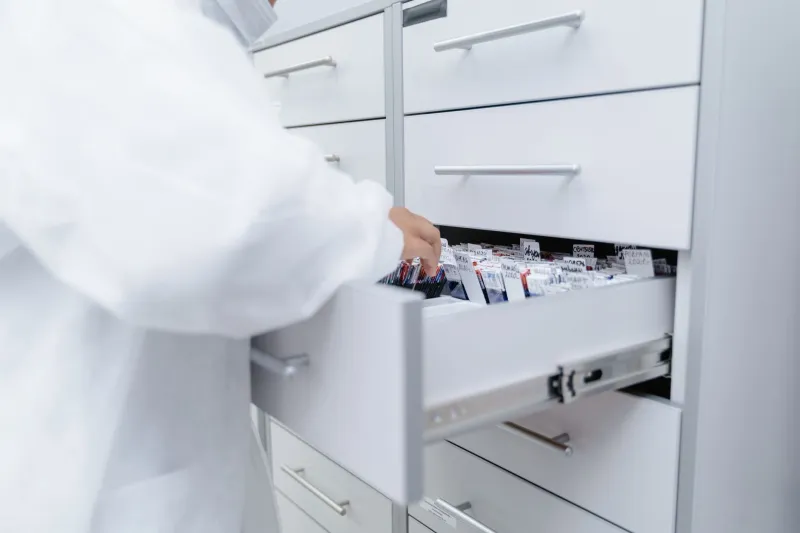
Inventory and provenance. A storage audit begins with knowing what is present. For each antibody, record the supplier, catalogue number, lot, concentration, formulation, storage recommendation, date received, number of aliquots, physical location and nominated owner. A spreadsheet can suffice, but it should be linked to assay records rather than maintained as a separate list that drifts out of date. Shelf maps are simple and useful: they reduce door-open time and make it possible to find a vial without disturbing an entire rack.
Temperature evidence. A single display reading is not a temperature record. A calibrated data logger, placed to capture representative conditions, provides evidence of minimum and maximum temperatures over time. Temperature mapping—checking several positions in the unit—is worthwhile for shared equipment, especially where door openings are frequent. Alarms should notify someone who can act, not merely sound in an empty building. For units holding irreplaceable reagents, a documented power-interruption plan and an uninterruptible power supply or backup freezer arrangement are proportionate considerations. UK laboratories have faced energy cost pressures and planned maintenance disruptions; the audit should ask what happens when the cold chain is interrupted, not whether it might be.
Freeze–thaw and aliquot practice. Record the number of freeze–thaw cycles for working stocks and date each aliquot. Thaw on ice or at four degrees Celsius according to the supplier's instructions, mix gently and avoid refreezing a working stock that has been warmed for use. Where an antibody is used infrequently, a concentrated stock plus freshly diluted working solution may be preferable to many small frozen aliquots. Document the thaw method as part of the standard operating procedure, because technique varies more than laboratories expect.
Formulation and compatibility. Record buffer composition, carrier protein, preservative and glycerol concentration. These details matter not only for storage but for assay compatibility. A preservative that is acceptable in one immunoassay may interfere with another detection chemistry. When speaking to suppliers, provide the lot number, formulation and storage history. Ask for stability data relevant to the intended use, but do not expect a supplier to validate a laboratory's own storage practice. That responsibility sits with the user.
Documentation that earns trust
Grant reviews and quality systems ask for evidence, not anecdote. A one-page storage record per antibody family can include the inventory details, temperature monitoring arrangement, freeze–thaw log, aliquot dates, formulation notes and any deviations. The record should attach to existing inventory, laboratory information management or quality systems rather than creating a parallel paperwork universe. A quarterly review, assigned to a named owner, is usually enough to catch drift.
For laboratories working within UK quality frameworks—whether ISO 9001, ISO 17025, ISO 15189 or an internal quality system—the audit should be proportionate to risk. A research group using a handful of well-characterised reagents does not need the same documentation as a diagnostic laboratory releasing patient-facing results. Both, however, benefit from being able to answer a simple question: what has happened to this antibody since it arrived?
When to escalate
Escalate when a temperature excursion exceeds the supplier's stated range, when a vial is found at room temperature for an unknown period, when precipitate or visible change is present, or when assay drift coincides with a storage event. Do not automatically discard the reagent. Quarantine it, label it clearly, compare it with a retained reference aliquot where available and contact the supplier for guidance. In a diagnostic setting, follow the deviation procedure and record the outcome.
The freezer is a controlled environment
The minus twenty freezer is not a set-and-forget appliance. It is a controlled environment, and antibodies are users of that environment rather than passive passengers. A modest audit—inventory, temperature evidence, freeze–thaw records and formulation notes—can prevent small failures from becoming unexplained assay problems. It also gives UK laboratories a defensible answer when a grant reviewer, quality auditor or supplier asks how their antibodies have been kept. The science does not need to be complicated; the record does.