The Step Between Add and Read: A Wash-Buffer Audit for UK ELISA Teams
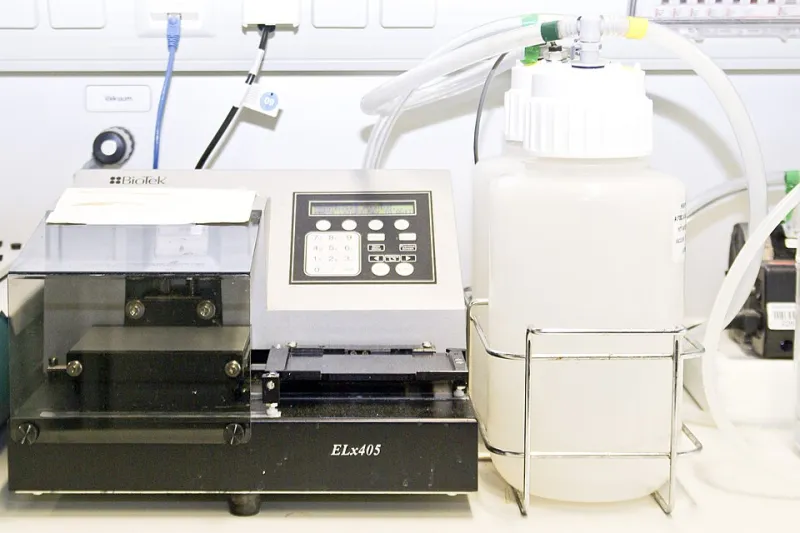
Photo: real name: Nadina Wiórkiewicz pl.wiki: Nadine90 commons: Nadine90, CC BY-SA 3.0, via Wikimedia Commons
In many UK ELISA workflows, wash buffer occupies an odd position: it is prepared in bulk, stored in a carboy and treated as laboratory infrastructure rather than as a reagent. It is not pipetted with the same care as a capture antibody, nor recorded with the same discipline as a conjugate. Yet it contacts the plate at every cycle, influences every binding equilibrium and leaves behind whatever the aspiration step fails to remove. The wash step is not a rinse between additions. It is an active separation step, and it deserves a specification.
Why the wash step deserves a specification
A wash buffer performs three functions at once. It removes unbound antibody, conjugate and sample components; it preserves the specific antibody-antigen complexes that carry the signal; and it maintains a consistent background so that small differences between samples remain interpretable. Those functions pull in different directions. A surfactant concentration that is too low leaves nonspecific material attached to the well. A concentration that is too high may strip weakly bound antibody or alter the conformation of the antigen. Salt strength changes ionic interactions and can either suppress or encourage nonspecific binding. pH affects antibody stability and the charge state of the plastic surface. Dwell time and flow determine how much material is actually removed, not merely how long the buffer is present.
For UK laboratories working to ISO 15189 or preparing IVD reagents for UKCA marking, the wash step also has a documentation dimension. If the buffer is not specified, it cannot be verified. If the plate washer is not calibrated against that specification, the assay is only partly controlled. The practical question is not whether wash buffer matters. It is whether the laboratory can demonstrate what it used, what it expected and what it observed.
Drafting a wash-buffer specification
A useful specification is short enough to be used at the bench and detailed enough to be audited. It should state the buffer identity, the source and grade of water, the surfactant type and concentration, the salt composition, the pH and conductivity ranges, the filtration or microbial-control step, the storage conditions and the assigned shelf life. Each parameter should have a tolerance, not just a target. A pH of 7.4 is a target; a pH range of 7.3 to 7.5 is a specification that can be checked.
The specification should also cover the plate washer as part of the wash system. Dispense volume, aspiration efficiency, manifold alignment, number of cycles, soak time and residual volume all affect the result. A washer that dispenses accurately but aspirates poorly can leave a film of unbound conjugate that no amount of additional buffer will correct. Calibration checks should include dispense accuracy across all channels and a residual-volume assessment after the final aspiration. These checks are not merely engineering tasks. They are assay performance checks.
A common mistake is to treat a published buffer recipe as a universal specification. Phosphate-buffered saline with a detergent is a reasonable starting point, but the optimum surfactant concentration depends on the antibody, the antigen, the plate type and the sample matrix. The specification should be established experimentally for the assay in question, then fixed and controlled. Change control should apply to surfactant lots, water systems and washer programmes as rigorously as it applies to antibody lots.
Testing against real sample matrices
Wash buffer is often optimised in buffer alone, then expected to perform in serum, plasma or tissue homogenate. That is an optimistic assumption. Matrix components can alter surface tension, foam formation and the efficiency of aspiration. A wash buffer that looks acceptable with clean controls may leave a higher background in lipaemic samples or fail to remove loosely bound material from haemolysed specimens.
A practical matrix challenge compares the chosen wash buffer with deliberate variations at the edge of its specification: a lower surfactant concentration, a higher salt strength, a pH shift of a few tenths of a unit, a shorter dwell time. The test panel should include negative samples, low-positive samples and samples known to produce elevated background. Acceptance criteria should be set in advance: background signal, signal-to-noise ratio, replicate precision and recovery of the low positive. The aim is not to find the most forgiving buffer, but to understand which wash parameters the assay can tolerate and which ones change the result.
This approach also helps distinguish a wash problem from an antibody problem. If several antibodies and sample types show the same shift when the wash buffer is varied, the wash step is a credible suspect. If only one antibody lot is affected, the reagent is the more likely source.
Separating wash drift from antibody failure
When an ELISA begins to fail, the antibody is often blamed first because it is the most visible reagent. A more disciplined sequence is to ask whether the failure is plate-wide, antibody-specific or sample-specific. A rise in background across all plates and all antibodies suggests a shared reagent or process, such as water quality, detergent lot, washer performance or buffer pH. A fall in signal for one antibody lot, with other assays on the same plate performing as expected, points towards the antibody or its conjugate. A failure confined to particular samples suggests matrix interference or a pre-analytical issue.
A paired run is a useful diagnostic. Run the same plate with the current wash buffer and a freshly prepared reference buffer, using the same samples and controls. If the reference buffer restores performance, the wash system is implicated. If it does not, the investigation should move to the antibody, conjugate or detection chemistry. Control charts for background and positive control signal can reveal gradual drift before a batch fails outright. These charts are more informative when the wash buffer lot, water source and washer calibration date are recorded alongside the result.
The quiet failures worth checking
Some wash-related failures are gradual and easy to overlook. Surfactant stocks can become concentrated through evaporation or diluted through repeated dispensing. Water systems can develop microbial contamination that introduces background. Tubing can harbour residue or develop partial blockages. Manifolds can drift out of alignment after service. A washer programme can be edited during troubleshooting and never restored. None of these failures announces itself as a wash problem. They present as assay noise.
A periodic wash audit should therefore include the buffer, the water, the washer and the plate. It should be short enough to run before a critical batch and documented enough to support an investigation. The following one-page template is a starting point for UK laboratories.
One-page wash audit template
- Buffer identity and lot: record the buffer recipe, surfactant lot, water source and date prepared.
- Measured parameters: record pH and conductivity against the specified ranges.
- Storage and age: confirm storage conditions, expiry date and whether the buffer was filtered or otherwise treated.
- Washer identification: record the instrument ID, programme name and date of last calibration or service.
- Dispense check: confirm dispense volume across channels and note any deviation.
- Aspiration check: record residual volume after the final aspiration and inspect for blocked or misaligned nozzles.
- Programme check: confirm number of cycles, soak time and final aspiration settings against the assay SOP.
- Matrix challenge: note whether the current buffer has been tested against the relevant sample matrix within the defined review period.
- Results review: compare background, positive control signal and replicate precision with the established acceptance criteria.
- Decision and sign-off: record pass, repeat or investigate, with the name and date of the reviewer.
The template is not a substitute for a full validation. It is a practical control that prevents the wash step from becoming invisible. In UK laboratories where assay time is tight and reagent costs are scrutinised, the wash buffer is an easy place to economise. It is also an easy place to lose reproducibility. The step between add and read is not plumbing. It is part of the measurement, and it should be audited as such.